
What a Japanese auction sheet is
A Japanese auction sheet is the inspection summary an auction house writes before a vehicle goes on sale, with an overall grade, an interior grade, a damage diagram, mileage, and the inspector's notes. Buyers outside Japan use it to judge a unit they can't see. The definitions below follow the rules of USS, Japan's largest vehicle auction group, as revised on 1 July 2015, and they were written for cars (trucks and specialist vehicles can be assessed under different rules, depending on the auction).
Japanese auction grades
| Grade | What it means under USS rules |
|---|---|
| S | Under 10,000 km, interior A, almost no scratches or repairs, up to 12 months since first registration |
| 6 | Under 30,000 km, interior A, no reconditioning needed, up to 36 months since first registration |
| 5 | Under 50,000 km, interior A, inconspicuous scratches and dents, no exterior parts replaced |
| 4.5 | Under 100,000 km, interior B or better, minor repairs would bring it close to a 5 |
| 4 | Under 150,000 km, interior C or better, a few conspicuous scratches, dents, rust, burns, or tears |
| 3.5 | Interior D or better, several areas needing panel work or reconditioning |
| 3 | Interior E, needs complete repair, replacement, or re-trimming |
| 2 | Low commercial value, such as corrosion holes in main body parts |
| 1 | Flood-damaged, or exposed to fire-extinguishing agent |
| R, RA | Repair history (RA is the lighter of the two at TAA and CAA) |
| X | Hard to evaluate, such as extremely old, replica, or special vehicles |
Interior grades
| Interior grade | What it means |
|---|---|
| A | Little or no reconditioning needed |
| B | Minor reconditioning, such as a few tears, burns, scuffs, or screw holes |
| C | Reconditioning needed, or defects that lower the value, such as many burns or cracks |
| D | Major reconditioning, such as many burn holes or tears, or a badly deformed dashboard |
| E | Major reconditioning throughout, such as large cracks, badly worn seats, or a strong cabin odour |
Each overall grade sets a minimum interior grade. Grades S, 6, and 5 need an A, 4.5 needs B or better, 4 needs C or better, and 3.5 needs D or better.
Auction sheet damage codes
The letter gives the type of damage and the number gives its size, with 1 the smallest. This table merges the legends of CAA, AS, and Car From Japan, and every auction house sets its own meanings (check the legend for the auction that issued the sheet).
| Code | Meaning |
|---|---|
| A1, A2, A3 | Scratches, from about 10 cm (A1) to larger than 30 cm (A3) |
| U1, U2, U3 | Dents, from about golf-ball size (U1) to football size (U3) |
| B | Dent with a scratch |
| E1, E2, E3 | Dimples, from a few to many |
| W1, W2, W3 | Repair marks or paint waves, from barely visible (W1) to needing repair again (W3) |
| S1, S2 | Rust, from surface rust (S1) to severe rust (S2) |
| C1, C2 | Corrosion, from corrosion (C1) to severe corrosion (C2) |
| Y1, Y2, Y3 | Cracks or holes, from minor (Y1) to large (Y3) |
| X | Part needs replacing (also used for a windshield crack) |
| XX | Part already replaced |
| G | Stone chip in the glass |
| P | Paint marking |
| H | Faded paint |
Mileage marks
USS marks a tampered odometer with an asterisk, a documented meter replacement with a dollar sign (with the readings combined), and a distance that can't be judged with a hash sign. A mileage management system run by the Nippon Auto Auction Association checks readings against stored data, and it can't check a vehicle that has no stored data, like one never listed at auction before. JEVIC also offers an odometer inspection that compares the reading with the vehicle's past readings.
What the sheet can't tell you
- Mechanical condition. TAA's inspection is visual, with the vehicle stationary, and faults that need parts removed or a road test depend on the seller's declaration.
- The manufacture date. The first-registration date on a sheet isn't the manufacture date.
- A guarantee. USS says it can't be held responsible for differences from its rating, and it doesn't accept price-reduction claims for several vehicle types, including repair-history vehicles, vehicles at 100,000 km or more, and exported vehicles.
Reading a sheet for a working truck
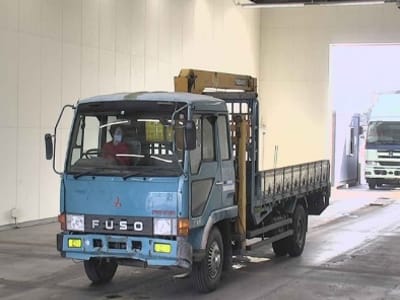
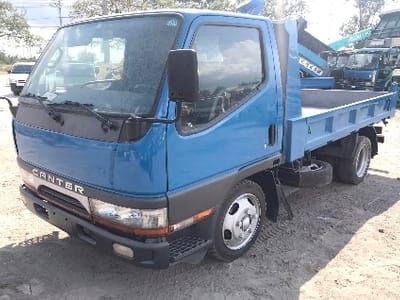
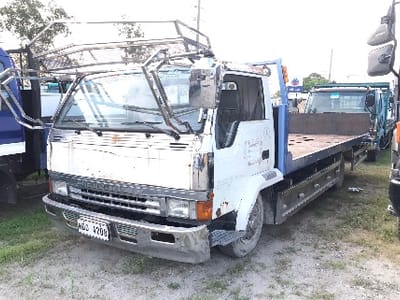
EveryCar, a Japanese exporter, notes that trucks and specialist vehicles may follow different assessment rules, and that a working body can affect business value as much as the cab or the exterior grade. For a dump truck, a self loader, or a crane truck, ask for photos or video of the body working (the hoist raising, the bed sliding, the crane extending) on top of the sheet.
Construction machinery auctions use their own evaluation formats, built around hours, the undercarriage, and the hydraulics (how Japan's heavy equipment auctions work).
Forged sheets
Editing or forging an auction sheet to hide accident damage or high mileage is a known scam, according to carskenya's guide to import fraud. Ask the exporter for the sheet from the auction that sold the unit, and match the lot details and chassis number to the vehicle (how to check an exporter).